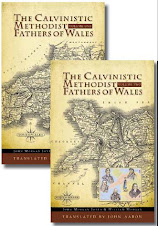
18 Jan 2011

Sermon on Lamentations 3:27

A sermon on bearing the yoke when young can be found here.
it is preceded by this introduction from Elias

TO THE READER.

Courteous Reader,
THE following Sermon was preached in the year 1812; but I had no intention at that time for it to be printed; nor had I endeavoured to set it forth in a proper method for publication. I was induced to preach on the text in Lam 3.27 by a heart-felt sorrow on account of the multitude of young people in Wales, who live according to their own sinful lusts, and under the dominion of Satan, rejecting the yoke of Christ, behaving themselves as if it were lawful for them to live ungodly while young, and to spend the days of their youth without being under the yoke and government of Christ; presuming that to live religiously for a few days under affliction, and in old age, will be sufficient. It grieved me to the heart to see the flower of men's time spent in the service of sin and Satan, and death seizing many of them without being under the yoke of Christ, and so thousands of them meet with the most dreadful disappointment. From these considerations, I endeavoured to shew them the miserable condition of those who were not under the yoke of Christ, with the preciousness and advantage of being under his yoke, and the special privilege of bearing it in the days of youth, &c. After some years had elapsed, some of my brethren informed me, that it had pleased the Lord to make use of the Sermon concerning the yoke, (imperfect as it was,) to be the means of bringing several young people to accept of Christ's yoke. They desired me to publish it: I opposed their intreaties for a long time; but at length, fearing I might sin in disobeying, I complied with their request. Having a few notes preserved on the text, and also a pretty full manuscript sent me from a young man who had wrote while I was preaching the Sermon, I endeavoured to recollect, so far as I was able, the things I had preached, and wrote them in the following manner, and suffered the Sermon to be printed. And although I know there is neither excellency nor perfection in the work, nevertheless, God, w ho is pleased to make use of weak means, may bless this poor Sermon for the good of some souls, and the glory of his own name; and if that shall be effected, I shall obtain all I desire, and shall be very willing to bear the blame of all my imperfections. That many may be brought under the yoke of Christ, and that those who are under it may be made submissive and thankful, is the prayer of
Your servant in the Gospel of Christ,
Llanfechell, July 10, 1818. JOHN ELIAS

Rowland, Elias, etc

You may be interested to know that these 14 (six in Welsh) Evangelical Library of Wales lectures from the seventies and eighties are available here. The whole site (Thomas Charles Institute) is worth a look.

R Tudur Jones on Elias

The 1975 Evangelical Library of Wales Lecture on Elias (John Elias Prince amongst preachers) by R Tudur Jones can be found here. A Welsh language version is also available.

John Elias & the CMs 1791-1841


This bilingual volume by the historian and prolific author, D Ben Rees, concentrates chiefly on Elias. The booklet published in 2008 is the substance of a lecture given the year before at Capel Ty-Rhys in Llangoed on Anglesey. The manner is lively and fairly even handed. The slant is definitely not an evangelical one but is respectful to the memory of Elias and full of interest. My copy is signed and is 128 of 500.

Enwogion Cymru entry

This entry is from the Enwogion Cymru "a biographical dictionary of eminent Welshmen, from the earliest times to the present, and including every name connected with the ancient history of Wales".


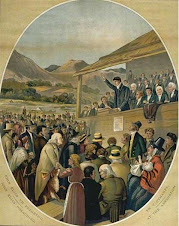
JOHN ELIAS One of the most eminent men that have distinguished themselves among the Welsh in late years, was born in the parish of Abererch, near Pwllheli, Caernarvonshire, in 1774. His parents though in humble circumstances lived comfortably and respectably, and from his earliest youth he was trained up in the path of religion. He joined the Welsh Calvinistic Methodists when a young man, and although he had no opportunity of receiving the advantages of a school education, yet so much had his zeal and promising abilities recommended him, that when he was about twenty years of age he was appointed an itinerant preacher. In 1799, he removed into Anglesey, where he resided during the rest of his life, but his ministry was not confined to his immediate neighbourhood, for according to the system of his connexion, he constantly itinerated through every county in the principality, and visited the large towns in England, where thousands of Welshmen resided without any spiritual provision whatever, and once in every three years he went to London. In 1811, when the Methodists resolved to ordain their own ministers, he was among the first who were ordained according to the new system. His biographer, from personal acquaintance, says of his remarkable powers in preaching "that he was a man of very acute, as well as vigorous and sublime genius. His mind was most penetrating, piercing like his eye. He exercised his great powers with much delight, in the field of the Scriptures. His strong intellect and solid judgment were clearly developed in his compositions, speeches, and sermons. Perhaps no mathematician could arrange his ideas better, and no logician could draw more correct and proper inferences from them, and no orator could bring them to bear on the people in a more commanding and influential manner, by the instrumentality of voice, manner, and eloquence. One might think, by his eloquent manner of speaking, that he was well acquainted with these arts and sciences. His discourses possessed amazing depth, solidity, and power. There was no lightness and superficiality in them." He was twice married, to his first wife in 1799, by whom he had a family, two of whom survived him, and
secondly in 1830, he married the widow of Sir John Bulkeley, knt. of Presaddved. He died June 8, 1841, in the sixty-eighth year of his age, and was buried at Llanvaes, near Beaumaris, and as a proof of the respect and esteem in which he was universally held by his countrymen of every persuasion, it may be recorded that above ten thousand persons followed his remains to the grave. An interesting memoir of John Elias has been lately published by the Rev E Morgan, vicar of Syston, Leicestershire, 12mo. Liverpool, 1844, which contains many personal anecdotes, and much valuable information, respecting the extraordinary influence which his ministry has had on the social state of the Welsh, since the commencement of the present century.

Four Stones


An interesting reminder of certain aspects of Elias's life from the point of view of a local historian can be found here. It is has been arranged in four parts with reference to four geographical points where stones can be found. The stones are

1. The Tre'r Gof Uchaf Stone  2. The Llanrhwydrus Stone 3. The Llanfechell Stone 4. The Llanfaes Stone


14 Dec 2010

Abererch

Crynllwyn bach, Aber-erch (birthplace of Revd John Elias)
Abererch where Elias was born. More here.