31 Jan 2023

Silhouette, c 1830


National Library of Wales, Public domain,
via Wikimedia Commons

28 Mar 2021

The Established Church

These words are found in The Life and Speeches of the Very Rev. J. H. Cotton ...

I was in union with the Established Church and with the Calvinistic Methodist body and the Methodist Deacons were grumbling rather and wanted me to stand by either of the two and sever my connection with the other. I had some hestitation about this. Subsequently Mr Elias was to preach here on a Sunday and on Saturday the 7th of May 1840 I started to meet him for the purpose of having his opinion and advice on my case. And this is what he said. 'Never separate from the Communion of the Established Church, nevertheless you can be in connection with us because we are a branch of the Church. These are his words word for word.'

Staffordshire Pottery Figure


This 19th century figure is from a collection at Attingham Park, Shropshire.
In the alternative below he is holding a Bible.

Transmission of Biblical Visual Imagery in Calvinistic Methodism

This paragraph is from an essay by D Huw Owen on The Transmission of Biblical Visual Imagery in Calvinistic Methodism/Presbyterian Church of Wales

Hugh Hughes had moved to Caernarfon by 1835, and William Roos, a native of Amlwch, had already moved there, as in the previous year he had advertised his availability as a portrait painter. Caernarfon developed into an important centre for artisan painters, with several of them competing with Hugh Hughes for commissions from the middle class. William Roos claimed that he had completed a portrait of John Elias in 1839, the same year as Hugh Jones's famous portrait of the renowned preacher. An engraving of this portrait was commissioned in 1840, probably on account of the connection between William Jones, the portrait painter from Chester and the artist's brother, and the publisher Edward Parry. This portrait, the basis for Samuel Benin's engraving published by Edward Parry in Chester, became a very popular icon in Wales, as also was the one of Christmas Evans, the Baptist leader, painted by William Roos in 1835. It is uncertain whether an engraved version of William Roos's portrait of John Elias was based on an oil painting by him, either the alleged one in 1839, another one in 1841 or a copy of Hugh Jones's work. The suggestion has been made that this engraving was the basis of the Staffordshire figure of John Elias, which, together with those of Christmas Evans and John Bryan, the eminent Baptist and Wesleyan Methodist preachers, were extremely popular. William Roos also produced in the 1830s an oil painting based on Hugh Hughes's portrait of 1812, but influenced by Bailey's engraving of 1838.

26 Sept 2020

Anti-slavery

Abolition did not become a popular movement until 1787 but you get this preparatory period where people like Williams Pantycelyn are saying that this slave trade is not right.
Later in the 1790s when abolition was a popular – even fashionable – movement Welsh Christians like Morgan John Rhys are outspoken against slavery. One important evangelist of the time – John Elias from Anglesey – preached against slavery in Britain’s biggest slave port, Liverpool.

“Much was said about the sinfulness of the slave trade when we were in Liverpool recently. We found that some of the brothers were working on the ships which were used in this vile trade, yes, and one of them was forging the chains which would be used to enslave these poor souls; we urged them to abandon his task immediately; we urged everyone not to be involved with any aspect of this cruel institution. It is better to die of hunger than to have plenty of bread by being partakers of blood.”

(Not sure of the source for this)

27 Feb 2020

Edward Morgan Biography

The Edward Morgan Biography can be accessed here.

Anecdote 4

This is from Edward Morgan's original memoir of 1844 with an introduction by J K Foster
Rev. E. Williams, of Radnorshire, favoured me with the following anecdote respecting Elias's increasing renown from the commencement: “I heard my father, one of the heavenly pilgrims in those days, who went to glory about the same time as Elias, say, that when the report of his popularity first reached South Wales, the church sent him and another leader to the Bala Association, under strict orders to prevail on him to visit them in that country. My father arriving there, met with one of the first preachers, Mr. John Roberts, of Llangwm, and asking him, will it be agreeable that we should solicit Elias this year to preach in South Wales? He answered, “Pray, don't attempt that now, leave him alone that we may see what the Lord means to do with him. It is probable that he will be raised up very high, or permitted to come down greatly. Our opinion of him is, that he will be a great minister, if he should not be spoiled as he is reared up.” Such was their fear lest young preachers should be injured, by being puffed by popularity.”

26 Feb 2020

Anecdote 3 An Elias Sermon

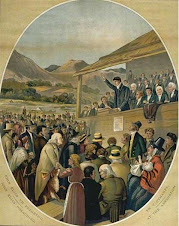
John Elias was preaching at an open air meeting in Holyhead when some drunkards joined the throng, attempting to disrupt his sermon. This was John Elias' response -

"Are there drunkards here? I’m afraid there are: May I make an appeal to you? Will you just for today try to control yourselves? …What shall we do with them brothers? ...I feel a desire," he said, as he became more agitated, "to put them up for auction to anyone who will take them, so that they will never bother us any more." Then stretching forth his arm as though he were holding them in his hand, he shouted at the top of his voice, "Who’ll take them? Who’ll take them? Anglicans, will you take them? ‘Us!! In our baptism we profess to reject the devil and all his works. No, we will not take them.’"

Are there drunkards here? I’m afraid there are: May I make an appeal to you? Will you just for today try to control yourselves? …What shall we do with them brothers? ...I feel a desire," he said, as he became more agitated, "to put them up for auction to anyone who will take them, so that they will never bother us any more." Then stretching forth his arm as though he were holding them in his hand, he shouted at the top of his voice, "Who’ll take them? Who’ll take them? Anglicans, will you take them? ‘Us!! In our baptism we profess to reject the devil and all his works. No, we will not take them.’"

"Then a moment of silence followed. "Congregationalists, will you take them? ‘What? Us! Many years ago we left the Church of England because of its corruption. No! We will not take them.’" Silence again.

Then, with his arm stretched out, he shouted again, "Baptists, will you take them? ‘Us! We immerse all our people in water to show that only the clean are acceptable to us. No! We will not take them.’" Silence again. "Wesleyans, will you take them? ‘What Us! Good works are an issue of life with us; we do not wish to have them.’"

Then stretching his hand out as though he were holding them in it, and casting a glance over the crowd, he shouted at the very highest volume of his voice, "Who will take them? Who will take them? Who will take them?"

…He turned his face towards the left, and in a rather low voice, and yet distinct enough for the whole congregation to hear, he said, "I rather thought I heard the Devil at my elbow saying, Knock them down to me; I will take them.’" Then, he raised his eyes, and with a grave, extremely serious look on his face, he searched the congregation with his eyes and for about a quarter of a minute, he never said a word.

…and then [he] shouted with tremendous force until his voice echoed thought the town, "I was going to say, Satan, that you could have them: but…"

and he raised his eyes towards heaven, and with a victorious, yet tender voice, he cried, "I hear Jesus shouting, ‘I will take them; I will take them; to wash them of their filth, to sober them in their drunkenness; to purify them of all their uncleanness in my own blood.’"

21 Jun 2019

Quotations from the Journal


These quotations are from Elias's journal as recorded here

"We stand in need of those fresh, powerful manifestations from heaven. We are, alas! accustomed to go on with the service of God in human strength; praying, hearing and preaching in that way! We are so lukewarm, without the light and the power of the Spirit! We neither feel nor see others experiencing His powerful operations! It is not often that unbelievers may, when they come to our congregations, cry out, ‘God is of a truth among you.’ And, alas! there is hut little lamentation on that account!"

"Ministers seem often satisfied with having freedom to speak, and seeing many hearing them with attention and delight; but alas! without experiencing the effects of the power promised to attend the ministry of the gospel, the power necessary to produce a saving change in the sinner1 The ministry neither alarms, terrifies nor disturbs ungodly persons who sit under it…No experimental, thoughtful Christian can deny that God has withdrawn Himself from us, as to the particular operations of His Spirit and the especial manifestation of His grace."

"There is but little thirst for the gracious and powerful visitations of God, and also, the prayers for these blessings are weak and cold…Is there not reason to fear that the prayers of many of us are merely customary and formal, asking many things without feeling the need of them? We seldom inquire whether our prayers are answered; and if not, what hinders them? Do we avoid indulging in those thoughts or practices that hinder and mar our prayers? Are we indifferent as to the aid of the Spirit in prayer? O seek His face – His face; seek Him with all your heart! There are many in the church, I believe, who have seen better days, but they sleep heavily now."

"It is difficult to judge by the fruits of hundreds of professors that they are godly! There are signs of worldly-mindedness in many of the aged. In others there is a lack of principle in doing righteousness. The young people conform to the world, following its ways and foolish fashion. Others delight in wrangling disputes, and foolish and unprofitable questions. There is a multitude of mixed people lusting after the things of Egypt – hankering after the expressions and the baser things of other denominations and religious parties. They delight in swimming in the stream of the spirit of the age in things political and religious."

17 Aug 2017

Preface by Elias now in print

Banner of Truth have just republished John Hurrion's book on Particular Redemption. It includes a preface written by John Elias for the Welsh language edition that John Aaron has translated into English. You can see the original here.

16 Aug 2017

Iain Murray on Elias


You can read an excellent essay on Elias by Iain Murray in his book Seven Leaders. The essay gives a brief life of Elias and then discusses Elias as a Watchman and then his defence of Calvinism towards the end of his life. Well worth reading in order to understand Elias and his times and what followed.

14 Aug 2017

Edward Morgan's Preface to his Memoir of Elias

THE Lord's ways with his servants are remarkable. Such they were in my being disposed and led to write a Memoir of the late Reverend John Elias. Satisfied that it was my duty to make the attempt, and sensible of my own weakness, I humbly looked to God for the aid of his Holy Spirit, to enable me to accomplish my purpose with fidelity and propriety. The writers of Biography generally find much difficulty in obtaining materials for their compositions, and in arranging them under proper heads; and I was not exempt from the common lot. I obtained, however, great assistance from three sermons preached on the death of Elias, and from other published accounts of him, as well as from his Auto-biography. My own thoughts being mixed with those of the preachers, and with those of the short pieces in periodicals, I could not, with the exception of Gwalchmai's and two or three other works, acknowledge my obligations. Some prefer being unknown. Elias's observations on the eclipse and other statements, are from authenticated sources.
The reader will find the notes increase as he approaches the end of the volume: this is owing to the necessity of confining the work to a certain number of pages. In order to make the Memoir concise, I abridged some of Elias's letters as also those of others, leaving out what was extraneous.
My apology for the style of the work, is its suitableness to my readers, who generally approve of simple language, and to the subject of the Memoir, who was himself remarkable for simplicity.
The glory of God and the good of souls, not a party either in politics or in religion, should be our object in writings of this kind; and I have therefore avoided all use of Elias's Conservative views, and have made no unkind reflections. The support Elias gave to the National Church might have been urged on his admirers, but this would not have increased the general usefulness of the volume.
It would be well, if while every minister prefers his own connexion, he could cherish affection towards all who belong to the church of Christ; and if, under this feeling, he were to refrain from either unduly exalting his own denomination, or depreciating that of his brother. The growth of Popery especially urges this duty, at the present time, on all Protestants. When will all who love the common Lord, unite to oppose the common enemy? Let us pray that the spirit displayed in the union of orthodox Dissenters with the Church in opposing the recent Unitarian chapels' bill, may be continued, and show itself in many ways, for the glory of God and the honour of his church. Providence also led me to a suitable friend to write an Introductory Essay to the work. I was much pleased with Mr. Foster's Essays, prefixed to the two volumes of “The Life and Times of the Countess of Huntingdon:” they are so excellent, so free from party spirit,-yea so self-denying as it respects his own connexion - that of the late Countess.'
There is an expression in one part of Elias's Auto-biography in favour of the Established Church, which I of course translated into English like the rest, as it was intended by him for publication. I showed the chapter containing the above to one of the most respectable preachers in the Calvinistic Methodist Connexion, before it was printed, and he made no objection. It is true that Elias did some 33 years ago allude, on a certain occasion, to the imperfections and abuses of the church.
A few lines in the Diary have been unintentionally omitted; they merely relate to Elias's joy in thinking on his dying bed of some truly decided, devoted, and spiritually minded ministers in the connexion, never giving way to any improper suggestions of the multitude.
The Countess herself was truly attached to the English Church; and her intention at first was to educate pious young men for Episcopal ordination; but alas! the Bishops would not accept them as candidates for orders. She then indeed sent them to preach under an ordination of the Presbytery: though such is the liberality of her College, that the students are allowed to join the National Church, or any other body of Christians, as they see fit; and a considerable number of students have entered the Establishment.
This denomination, of whose college at Cheshunt Mr. Foster was for upwards of thirteen years the tutor, is much like that of the Welsh Calvinistic Methodists, both in its origin and spirit. The most eminent clergymen at the head of the latter, were chaplains to her ladyship; and they used to preach in her chapels, as well as English clergymen, such as Romaine, Venn, and Berridge.
Elias was highly esteemed by men eminently useful in their generation: Mr. Jones of Creaton once said, it would be worth while to acquire a system of short hand in Welsh, in order to take down Elias's sermons.
It is my intention, if spared, to publish some passages selected from his sermons, and also observations on his works, together with his letters to relatives and friends.
The Auto-biography will be found distributed into appropriate chapters, a use, which from the Rev. H. Griffith's letter to me about the time of Elias's death, appears to have been the intention of the deceased. “Mr. Elias finished his Memoirs, that is, as much as he intended writing; this may serve,” says this confidant of Elias, “as a guide for those who at any future time, may undertake to publish his biography; and also as a standard to write correctly respecting him.”
A consideration of the extraordinary ministerial powers and success of such preachers as Elias, has a tendency to humble ministers, by causing them to see how insignificant are their own labours: they are however taught to look unto the same God who qualified him. There is a loud call that ministers should be more alive and active in the vineyard, knowing that their day of departure is at hand; and there is provided sufficient aid to enable them to follow their fathers in the paths of usefulness. 
Syston, September 20th, 1844.

15 Aug 2015

Elias's Grave 1841

Fron, Llangefni

On February 10 1830 Elias married Lady Buckley. They lived in Fron, Llangefni.

Elias's birth place 1774

Crymllwyn Bach (see here)

Capel Pentreuchaf

This is the chapel where Elias read the Scriptures to the crowds waiting for the preacher to arrive, in 1782 (see here)

Capel Abererch

This is the Chapel in Abererch where Elias was baptised as a baby (see here)

8 Aug 2015

Elias and Christmas Evans contrasted by Owen Jones

Christmas Evans … there was in this eminent preacher a strong tendency to light humour. He often sent his audience into convulsions of laughter, which bordered at times on indecorum in the house of God. It is a question of interest how far this is allowable in the pulpit. There is a quiet kind of humour which is perfectly becoming with the sublimest and loftiest themes. But the droll and the laughable are certainly unbecoming, and unworthy the dignity of the high message of God to man. John Elias never was known to say anything with such a tendency in the pulpit, and he condemned it severely. Henry Rees was the same. Daniel Rowlands and Robert Roberts, Clynnog, never descended to anything bordering on the comic before the congregation. Williams, of Wern, was somewhat inclined to it in the first year of his ministry, but soon abandoned it for ever. John Jones, Talsarn, gave reins to his humour at times when preaching. But Christmas Evans did so more than any other. It is possible that Christmas Evans had a greater natural tendency to this, arising from a keener sense of the ludicrous; and that it required a greater solemnity and a greater insight into the purposes of God in order to hold it in check. We believe that this was the case with him. When God is present there is nothing more discordant than frivolity of whatever degree. They repel each other. Think of the great sermons of the New Testament; the atmosphere around them is so fine and attenuated that these cannot exist therein. …
 
John Elias was wanting in humour. At least, we have been able to see in him but few traces of that noble quality. His mind was altogether bent to the solemn aspects of truth; his eyes were turned to the stern realities of the other world; with difficulty could he turn his eyes to the imperfections of this earth. He was like another John the Baptist, who had spent his time in the wilderness without having seen much of the beauty of nature. He was as if he had spent much of his life on the rugged sides of Snowdon, or under the overhanging rocks of Eryri; as if he had been cradled and nurtured on the slopes of the everlasting mountains, without ever having seen the lovely glens and valleys, the green fields and the lilies. But, if he had not seen these, he had seen the great ocean, and delighted to look at the mighty billows that wash the feet of these everlasting mountains; and he often left the rugged slopes for the level shore and the loud sounding sea. It was the great and grand, the awful and sublime, that he made his home with; the pleasant, the delightful, and the lovely he had no eye for. His house was built on the rocks of law, justice, and eternity, in sight of the ocean of everlasting love. But, if he did not delight his hearers with his humour, &c., he brought into their bosoms joy unspeakable and the peace of God, which passeth all understanding. There was abundantly more of the pleasant and delightful in Christmas Evans and Williams Wern; and they were greatly his superior in the possession of the quality of humour.