Regarding the great Welsh Calvinistic Methodist preacher
John Elias 1774-1841

08/03/2012

The Marquis and Elias


This appeared in 1857
Translated from the Welsh, by a Clergyman, for the Christian Witness.
About forty years ago, or at least about ten or twelve years after the formation of the Bible Society, it was beginning to draw special attention in every country. This was the case in Wales, and especially in Anglesea and Caernarvon
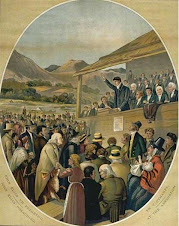
About this time public meetings were to be held in the towns of Caernarvon and Beaumaris. The Marquis of Anglesea was invited to take the chair. The illustrious nobleman kindly accepted the invitation, and promised to become an annual subscriber of ten or twenty pounds. This produced a great sensation through the Principality. It came like wildfire on the feelings of many in the country. It gave great offence to many of the most respectable in the land, and caused no small terror in the camps of those who were prejudiced in their minds and narrow in their principles. Attempts were made to persuade the Marquis that it was below his dignity thus to mingle with the Dissenters, and that he would do more good by joining another society that was already in existence. But the Hero of Waterloo could not thus be diverted from his course. After having made up his mind, he would sooner have suffered another limb to be cut off than to forfeit his word. The Marquis was probably the first nobleman in Wales who advocated the cause of the Bible Society. The meetings were advertised, and Dr. Steward, of Liverpool, was announced as one who was to speak in English, and John Elias in Welsh. It was thus seen that the Marquis could not be turned from his purpose. It was concluded that his presence would draw to the meetings many of the higher ranks, though to some of them it would not be a very pleasant thing. The Marquis had been lately crowned with the glory of the ever-memorable Waterloo, and had been in many ways highly honoured. His monument had been lately erected near the Menai, in Anglesea. The gentry who had lately assisted in erecting that monument, could hardly decline to meet him on the present public occasion. They all thought that it would be better for them to be present, and to allow Dr. Steward, as a stranger, to speak; but that it would be advisable to excuse John Elias on such a public occasion, as he could exercise his talent at meetings less public throughout the country. They could not bear the thought of hearing him, though they did not expressly say so; but they intimated that he might be excused on this occasion. The proposal was made to the conductors of the society, but none of them would consent to have Elias put aside. They were all agreed that he should address the assembly.

The day of meeting came, which all the country were looking forward to with the greatest interest. There was hardly a family, either in Anglesea or Caernarvon, from which there was not one or more present. There were there ladies without number, from every part. Everything was now ready to begin the meeting, and the place was full of hearers. Great anxiety was now felt in every bosom, and all were looking towards the door, and listening whether there was any symptom of the approach of the chairman, and expecting every moment to hear the trampling of the horses' hoofs on the pavement. Anxiety was becoming greater and greater as the time to begin was approaching. There was no appearance of the chairman coming within live minutes of the time to commence. Now there was a whisper that the chairman would not come to the meeting. This threw a damp on the whole, as though a thick dark cloud had spread over the whole place. But, hear! as the clock began to strike eleven, the noise of the chariot was heard at the door, and there came in the great man, and was immediately conducted into the chair; joyful animation pervaded the whole place at once, and there was a smile on every face. Well! every one was in his place, and silence throughout, and the important business of the meeting commenced.
The chairman arose, explained the object of the meeting in a few words, and said that he wholly approved of the design of the society, and that he deemed it a privilege to co-operate with others in so blessed a work. After reading the report, and going through the usual course, the speakers were called upon, who made motions and addressed the assembly; and everything went on in the most pleasing manner.
At last,John Elias is called upon by the chairman to speak. Strange was the appearance of many at this time; some turned their backs on him; and others, not turning their backs, looked sideways at him, with a pouting lip and scornful eye. Well, be it so, such things did not daunt him. He came forward, and courteously bowed to the chairman in a dignified manner, which the chairman acknowledged by a smile. He instantly saw that he had no common man before him. Our old friend began his work. Though his name was detested by many, his very appearance seemed to have slain one half of their prejudice, and his graceful address had nearly the effect of slaying the other half.
He began by showing the state of Wales before they had the Bible. He showed, in a few minutes, that he was quite at home in the history of his country. The assembly was a mixture of English and Welsh j some understood him, and some not. When he came to narrate the history of the Welsh translations, and mentioned William Salusbury, Dr. Morgan, Dr. Richard Davies, Thomas Hewitt, the Chancellor of St. David's, Dr. Whitgift, Dr. Hughes, Dr. Bellit, Dr. Gabriel Goodman, Dr. David Powell, vicar of Rhiwabon, Archdeacon Prys, Dr. Richard Vaughan, Dr. Parry, and others, such sounds descended on their ears as they little expected; and all those dear names were like music to their hearts. And as he went on, giving an account of the various editions of the Welsh Bible, naming Thomas Middleton, Rowland Heylin, Walter Cradoc, Vavasor Powell, Thomas Yonge, Stephen Hughes, David Jones, Bishop Loyd, Moses Williams, the Morrises of Anglesea and others,— and as they saw that the whole history was as familiar to him as the letters of the alphabet, they could not but listen to him. And after he had gained their attention, melted their feelings, and warmed, their affections, all the frost, somehow or another, melted away imperceptibly! After he had gone on awhile in his speech, his powerful words, his good language, and his attractive eloquence, so prevailed, that there was no back nor side turned towards him, but all looked on him with intense interest.
After; having led the assembly to take a view of the state of things in Wales; and showed the necessity of having some provision made for them more effectual than any yet found, notwithstanding all the efforts that had been made, every one present seemed to have forgotten his narrowmindedness and every feeling was wholly fascinated. Then he took up another subject: he described the moral condition of the. country at that time; war being, as it were, carried on between light- and darkness - between holiness and sin — between Christ and Belial; and:the two great armies drawing nearer one another, and the intervening space narrowing every day; and the necessary consequence being, that truth should prosper, and gain, finally, the victory. He showed that the happiness of the world depended on, the issue of this contest. He said that an example and a type of this contest and victory had been lately exhibited on the field of Waterloo. By this time the feelings of the whole assembly, were wholly at his command. The ladies had for some time been softened and melted. Some were seen dropping, imperceptibly, their handkerchiefs from their hands; and others, their gloves; and the same feeling pervaded all. He went on to describe the late contest at Waterloo, and showed how the fate of nationsthe peace of the world, commerce, the hope of art and science,, the increase of knowledge, yea, and the free progress of the Gospel, depended on the issue of that important day. But the hand of Providence was evidently seen there. The generals were gifted with wisdom and valour necessary for the great contest. "The Lord is a man of war: the Lord is his name." In describing; the Marquis going forth to the battle, he borrowed the account given in, Job, of the war-horse and his rider. .... ... Elias went on in his speech, and as he became stronger in power and more fiery in his spirit, the effect continually increased. "I could imagine," he said, "that there was the shout of, victory before it was won: yes, but it will be a victory at the cost of life to one of the chiefs of our nation! No, it will only be the loss of one limb. At this time behold, Death came forward and threw a ball which shattered his limb; but what of that, here is Providence on the battle-field at:the same moment, and shouts to Death, as the angel shouted to Abraham. Hold thy hand; hitherto shalt thou go and no further. Don!t touch his life, dare not go an inch nearer his life than the limb. I shall want his service again as a general in a war of far higher order than this; I shall want his service to preside in the chair of the Bible Society. I shall want him to lead on an army to spread the word of life to every country and language and people and nation, over the whole earth." He then cried in a strong voice, and yet very melting, "The enemy is bound, but God's Word can never be bound." The whole assembly was by this time completely overpowered. And the English, noticing the thrill which pervaded the assembly, were asking, "What - what was that?" "What did he say?" etc.
When things became quieter and the feelings were .somewhat allayed, the chairman nodded to a friend not far from him; that he might know the cause of the Commotion 'he had witnessed. His friend drew near him. and whispered to him, "It was an allusion to yourself, my Lord, and the accident at Waterloo, When the interposition of Providence spared yo'u to preside over this meeting," etc. So affected became the-Marquis, that the big tears rolled down his cheeks. Let the reader now Imagine, if he can, what were the feelings produced in the Whole assembly at this time.', Behold, the manly warrior is weeping like.a child!
There was no sufficient power in all the cannons at Waterloo to touch his feelings, for he remained as hard as the rock: out here is a Welshman's speech, which turned a flint stone into a pool of water! There was no sufficient strength in the ball which shattered his limb to daunt his spirit: but here, an address at a Bible Society meeting had such an effect as to soften one who had set his face as a flint, until he became so tender, so meek, so feeling as a little child!
After this,John Elias finished by making an earnest appeal to the people, grounding it on the words of the Apostle "Finally, brethren, pray for us that the Word of the Lord may have a free course and be glorified."

17/02/2011

Obituary

This obituary for Elias appeared in the Christian Reformer or Unitarian Magazine
On Tuesday, the 8th of June, aged 68, at his residence, Fron, near Llangefni, in the island of Anglesey, the Rev. John Elias.
He was, perhaps, the most popular and the most laborious of all who hare engaged in the ministry among the Welsh Calvinislic Methodists, by far the largest religious denomination in the Principality. (See Christian Reformer, Old Series, Vol. XIX. p. 422; New Series, Vol. VIII. p. 270).
His parents were in humble circumstances: originally he was himself a weaver, and he enjoyed few of the advantages of early education. His chief characteristics in after life were, a clear and masculine understanding, great tenderness of feeling, a discriminating judgment, strong reasoning faculties, and a spirit of genuine, unpretending piety. His preaching was always in Welsh; and in compass, vigour and brilliancy of language, he had no rival.
The standards of Calvinism were his rule of faith. He was zealous for his own system of doctrine; he was also zealous for those great essential truths of our religion which appear so prominently and so distinctly in the New Testament, that they have never been entirely obscured and forgotten. He could exuibit,such extensive views of what he regarded as "the' deep things of God," and of the requirements of the gospel, of its awful denunciations and its precious promises, and could connect them with pictures of the human character so vivid and often so true to nature and to our experience, that he seldom failed to touch and even to thrill the heart. All his ideas were arranged in luminous order, and he had a quick perception of what belonged, and whatidid not belong, to any question that came before him. He knew how to reject all that was extraneous; hence no one could mistake him. Whatever opinion might be formed of his conclusions or of the force of his arguments, his hearers were sure to understand his meaning; and without the appearance of any effort, he always left a strong and well-defined impression upon their minds. He had no turns of thought remarkable for nothing but their strangeness, no smart, sparkling witticisms, no false transports. It was not his practice to deal in satirical, sarcastic remarks, and he was entirely free both from coarseness and from flippancy. For the most part, his sentences were simple, but they were never cast in a rugged or careless mould. When he adopted a colloquial style, he took the utmost pains to avoid every thing like vulgarity. He was familiar with the works of some of the most distinguished preachers of a former day; such as Owen, Charnock, Hopkins, Baxter and Flavel; and though it cannot be said that he formed himself on the model of either of those eminent men, it was impossible not to be struck with his occasional approaches to their habit of thinking and their phraseology. He preached not to amuse but to convince; there was an earnest solicitude about him, which gave an elevation and a persuasiveness to his discourses far more capable of awakening a deep and lasting interest, than the most admired specimens of artificial eloquence.
The expression of his countenance, the tones of his voice, and his gestures, strikingly corresponded with what was passing in his mind. His whole manner was artless, dignified and graceful.
If we take all these circumstances into consideration, we shall be at no loss to account for the extraordinary attraction of his public addresses, or for the magical dominion which he had over his auditors, whatever might be their age or their attainments. The sorcery arose not more from the strength than from the versatility of his genius.
It is only justice to remark, that, unlike too many who believe that " in this ruined world " they are from their birth the true and exclusive heirs of all the mercy of God, he never encouraged persecution, under pretence of extending the spirit and the influence of Christianity.
The qualities of his social and private character were of the most amiable and engaging kind. He was warm and acutely sensitive in his strongest affections, most faithful in his attachments of friendship, indulgent and generous to all with whom he had intercourse. He could be cheerful without levity, and grave without moroseness. He could mix with men of the world when occasion required it, without compromising his principles, or in the slightest degree lowering his character as a minister of the gospel; and his presence was enough to check in a moment whatever had even the semblance of irreligion. Among his confidential acquaintances, independently of the interest which his high reputation cast around him, he was delightful. While he drew with ease from his varied stores of information, there was about him a child-like, ingenuous simplicity, which redoubled the charm of his conversation. To that native frankness of disposition which is the surest indication of a great mind, he added an unaffected kindness and cordiality which at once gained the hearts of the youngest and most inexperienced who applied to him for counsel or for comfort. He was peculiarly accessible.
But amidst all his attention to the claims of friendship, he never lost sight of the paramount value of the sacred office to which he had devoted his talents and his warmest love.
His dying illness confined him for about three months to his chamber. It was sometimes severely painful. He saw that the evening shadows were stretching themselves out, he felt that his course was nearly run, and he awaited the gracious signal of release in humble, unostentatious, calm and patient hope. His end was tranquillity itself: without the faintest groan or sigh, he fell asleep in Jesus.
His funeral took place on the Tuesday after his death. Agreeably to his own request, he was buried in the secluded, peaceful church-yard of Llanvaes, a scene of natural romance and beauty, the site too of an ancient monastery of Franciscan friars, more than a mile to the north of Beaumaris, and 15 miles from Llangefni. It is computed that not fewer than nine thousand persons were present at the solemnity. In the procession were forty-one vehicles of different descriptions and an hundred and eighty four separate horses. The day was uncommonly fine, labour and business were for many hours suspended, and a sabbath like quietness reigned through the whole district.
On the evening before the funeral, the Calvinistic Methodist chapel at Llangefni was crowded to overflowing. The attendants were all so absorbed in grief, that although they made many efforts to sing, they were obliged to desist. Forsaken and desolate, they "hung," as it were, "their harps upon the willows," and "sate down and wept." What a beautiful, affecting tribute of Christian love!

Critical review positive side 02

Preaching is eminently popular in Wales. It was then, and to a great extent, is still almost the only occasion of public assembling. The people are eminently theological. Stand and listen to two peasants on the mountain side, go to the field at harvest, to the mill, or the smithy, or mingle with Welshmen among the iron and copper, and coal works, aye, go the public house, and in a majority of instances you will find them discussing theology. Points of the most abstruse description, and difficult passages of Scripture, form the staple of their talk, in fair, in market, by the way, throughout the day's labour, and at evening's rest. Thus, we can easily account for that, which so much astonishes strangers visiting the principality in the spring and summer. When during such visits they attend the meeting of a Welsh association, they are astonished to find the most intense sympathy between a mass of four or even ten thousand people of all ages and conditions, and every word the preacher utters; and this when the discourse is so thoroughly doctrinal, that its principal portions would be utterly unintelligible to a congregation of English peasants. John Elias began to preach to such people in their own tongue. His qualification was then rather of the heart than of the intellect. The latter was but scantily furnished, while the former was swelling with love to God and to man. In youth he was mighty in the Scriptures. This gave him great power with a people who refer to the Bible to settle every kind of dispute. His connexional relations were also in his favour. He was engaged in an itinerating ministry. In the comparatively uncultivated state of his mind this circumstance aided him materially, as fewer sermons were necessary, and he had more time to give them completeness, while his repeated delivery of a discourse furnished opportunities for alteration and emendation; which advantages are virtually lost in a stated ministry. We trust we shall not be misunderstood, when we add that a narrower range of intellectual qualifications sufficed for the Calvinistic Methodists in Wales, during the greater portion of John Elias's life, than had been enjoyed by them during the life time of their founders, and than they must have, and are endeavouring to secure for themselves, henceforth. The founders of this denomination were almost to a man clergymen and scholars. When they were dying off, Thomas Charles left the Establishment and cast in his lot among them. As far as he had gone in the walks of literature, he was a ripe scholar. With the original languages of the Bible, and the English tongue, he was exactly and critically acquainted. Of the language of his native mountains he was a perfect master; and there is not in the principality any work to surpass, few to compare, with his Geiriadur as to purity and chasteness of style, apart from its other and manifold excellencies. These great men died and left behind them a large number of preachers, but not, with very inconsiderable exceptions, men of early mental culture. Their ministry has therefore of necessity, been destitute of the many nameless advantages which result from such culture, and this has habituated the people to a less varied kind of preaching than the two congregational denominations have enjoyed. Indeed, and they must not be offended by our plainness of speech, the Welsh Methodists have been most unfaithful to themselves in respect to their ministry. For many years they did nothing towards educating their preachers, beyond sending one now and then to Glasgow, and more often to Cheshunt, and latterly to Highbury. Some of these became congregationalists and settled in England, others settled over Countess of Huntingdon congregations, and with some two or three exceptions only the feeble returned home; latterly they have seen this subject in the same light with Independents and Baptists, and have now promising institutions at Bala and Trevecca.
John Elias as a preacher was created by and for this state of things. His popularity was not confined to Anglesea, or to North Wales — indeed, in this body popularity in one part of Wales is popularity every where. A minister ordained at the Bala association, and residing at Holyhead, is, during his visit, as much the pastor of the Methodist church at Cardiff, as he is of that in the town of his residence. The following is a brief account of one of John Elias's preaching tours. He leaves Anglesea for the association at Llangeitho. He preaches twice or thrice a day during his whole journey, and is followed by crowds from village to village. At length he arrives at the great rendezvous of Welsh Methodism. He preaches the evening before the association. Two strange brethren had been announced the preceding Sabbath, names not given. The principal part of the available population attends. A few strangers have arrived, ten or twelve blaenoriaid from Carmarthen and Pembrokeshires.some of them came last Saturday that they might spend one Lord's-day at Llangeitho before they die 1 Much have they spoken on the Monday about the olden men (yr hen ych). They have been anxious to know whether any body lives who remembers Daniel Rowland, and not taking into account the lapse of time, are disappointed to find that there lives in the neighbourhood but one woman who heard him preach, and that she is bed-ridden; and that the old man who heard his last sermon, and whom he shook hands with the last time he was out, died three weeks ago. Time for commencing divine service arrives — the capacious chapel is crowded — a stranger, in slow and measured accents reads a psalm, gives out one of William William's hymns, and engages in prayer. Another stranger ascends the pulpit, he is sad-looking, his hair straight over his forehead, clad in a blue single breasted coat, a black double breasted waistcoat, buttoned up under his chin, with his legs encased in patent cords and top-boots. He reads his text in a low tone of voice, with somewhat of a drawl; — the people know him not, but he is from the north, and of the connexion, and that is enough. He dwells at some length on the context, then gives his discourse: there is nothing great but it is sound orthodox matter; besides, he quotes Dr Owen, and perhaps Manton, or Flavel. A flash of light gleams, and then another, but he does not allow himself to get excited; and having succeeded in awakening and fixing the people's attention, he closes, invoking the Divine benediction on what they have heard, and, with emphasis, 'on what they shall hear.' John Elias then stands up — his face is strongly marked with clear and distinct expressions of real and personal character, somewhat 'sicklied o'er with the pale cast of thought f he is calm, self-possessed, and firm, and with a gravity so profound, that every approach or tendency to levity dies at once in his presence. He is a somewhat tall, slender man, his whole personal make and appearance denoting habits of untiring activity. 'Whoever this is (the observant hearer will say to himself), I feel I shall be bound to listen to him.' He gives out a single verse of Edmund Prys's translation of the Psalms, and then proceeds with his text — read with quiet, but most effective emphasis. He makes some interesting remarks of an obvious, but very appropriate character. Probably he takes some pains to settle the exact force of its principal terms, quoting some critical authority, but in the simplest and most unaffected manner. He divides the subject naturally, and becomes somewhat animated. The first head of discourse has been discussed, every body feeling that no more can be said upon it, so completely has he opened and laid it bare before their eyes. He approaches the salient point of the sermon, and his viva'ity increases, the right hand seems a thing inspired, its motions are an integral part of the matter, deeper and deeper grow the intonations of the voice, while the animation increases mightily. Nothing can be more measured than its cadences — and still they are instinct with living fire: they blaze, they burn, they scorch: the preacher pauses — look, now, at that right hand aloft in the air — look at the poising of that forefinger, once, twice, thrice; look at that face, the firmly compressed lips, the distended nostrils, the sparkling and brilliant eyes reposing themselves for a moment; the expansive forehead, bright and fair in all its manly beauty; a thousand human beings before him, with slightly opened mouths, suspended breath, and rapt attention, all hang on the lips of this once poor weaver boy; yes, he has got it; he has been looking at and into the people he has been catching a thought, and reimpressing his memory and his conscience with it, out it comes with all the splendour and energy and sublimity of the most finished, sustained and impassioned sacred oratory. The people tremble, weep, and are possessed — the charm is upon them — he sways them at his will — they move before him as shocks of corn before the breeze. He closes his discourse in a short prayer. Two men walk home together. The youngest asks, 'Who could that preacher be?' The other, somewhat contemptuously, replies, 'Who? John Elias, to be sure. Who else could preach such a sermon?'
When the whole scene has passed away, and the recollection of it remains, an unimpassioned analysis of the preacher s peculiar qualifications will perhaps produce some such result as this. It is not his personal godliness that distinguishes him; though that be eminent, other men are, in this respect, as eminent as he, and are immeasurably his inferiors in the pulpit. It is not the depth and closeness of his reasoning — many preachers in his own day, and country, and denomination, have been abler logicians, and far less prone to false reasoning—while they are dwarfs beside him before the public. It was not the power and excursiveness of his fancy, for he never excelled in metaphors, and those he employed were never original or striking. It is, firstly, the continued presence and influence of good common sense, and of a sober, if not always a sound judgment, in the selection of his subjects, and the manner of discussing them; secondly, a subtlety, though not a depth of intellectual power, which invested whatever he treated with an interest that freshened and brightened it up for the time, and smote the hearer with admiration and delight; and, above all, a well conceived, and consummately elaborated elocution. His greatness, his one greatness, was, we do not say matchless, but we do say, Unsurpassed Oratory. We think we have read all that has appeared in this country in the shape of accounts of Whitefield's eloquence, and we have no inclination to yield even him the palm; we have no idea that in mere oratory he was at all superior to John Elias. William Williams was eloquent, but it was the eloquence of his conceptions, while he was utterly careless of manner, and even of words. Christmas Evans was, on some occasions, mightier in his eloquence than John Elias, but it was when his imperial fancy led him aloft, and his hearers with him, and no more the result of previous elaborate study than are the complaints of a child But John Elias was The Orator. Inconclusive, and common-place, he might occasionally be, but otherwise than eloquent he could not be. He was The Sacred Orator, who devoted his long and godly life to the best interests of his country and of mankind. His career has closed, his remains lie at peace at Llanfaes, until the morning of the great and awful day, when the Son of God will come with the clouds to ransom 'the purchased possession,' to restore to the souls of his redeemed their glorified bodies, and "to deliver up the kingdom to God and his Father, that God May Be All In All."

Critical review positive side 01

The critical review in the Eclectic Review close with this more positive sketch (Part 1):

We subjoin a hurried sketch of John Elias; relying for dates, and biographical incidents, on Mr Morgan's authority.
He was born on the 6th of May, 1774, at Brynllwynbach, in the parish of Awerch, near Pwllheli, Caernarvonshire. His father was a weaver, and had some share in the advantage of a small farm, which he jointly cultivated with his father. This grandfather of John Elias took an early liking to his grandson, and with exemplary assiduity sought to direct his footsteps aright. He taught him to read, took him regularly to church, frequently conversed with him on questions of morality and religion, and especially succeeded in fastening his attention on the Bible. In the seventh year of his age, he was afflicted with the small-pox, and its effects debilitated him for some years; during which, many interesting conferences occurred between him and his devoted grandfather. On his recovering strength sufficient to move about, he accompanied the old man to church, and to hear celebrated Dissenting ministers, who, principally from South Wales, from time to time visit the north. Sometimes the preacher was late, and then John Elias was put to read the scriptures to the expectant people. On one such occasion, before he was twelve years of age, he was thrust into the pulpit to do so, and with trembling, read part of the Sermon on the Mount. 'At length' he says, 'I looked sideways, and observed the preacher standing by the door of the pulpit; I was greatly alarmed, I closed the Bible immediately, and came down as fast as I could.' The history of his boyhood, is the history of the constant struggles of his mind, under a conviction of sin, a desire towards God and his cause, and the corrupt propensities of his nature. At length it pleased Him who had separated him to His work and service, to give him liberty and peace by means of 2 Cor. v. 18, 19.
'About this time' he says,' the Lord was pleased to favour me with strong and clear manifestations of his mind by his Spirit in my soul, respecting the gospel, and his gracious method of saving sinners. A passage from the Scriptures struck me one day in a remarkable manner, and on a certain spot on my way to Pwllheli, which I well remember. It is 2 Cor. v. 18, 19,— the ministry of reconciliation: the expression came into my mind with new light and power. Oh! the enjoyment of my soul I God in Christ reconciling the world unto himself. I beheld the wondrous excellence and glory of the plan, which reconciles without imputing trespasses! I then perceived how that God effected this, by imputing our sins to Christ, and counting his righteousness to us. The doctrine of justification has ever since been of infinite importance in my esteem.'
Young John Elias soon felt a desire to preach the gospel to his fellowmen, but 'perceived,' (he says) the desire was not reasonable in him, who had not yet been received as a member of the church.' In September, 1793, he united in church-fellowship with a small Methodist society, at Hendre Howel. The good man at whose house he stayed, and with whom he worked, as a weaver, put him to engage in family prayer alternately with himself, and his devotional spirit soon became very eminent. He attended a night school, (Sunday-schools then 'were not,') which circulated through the hamlet. These schools were very religiously conducted, and it frequently devolved on John Elias to perform every service that was observed. He read Welsh well, and this he was often called upon to do, as well as to catechise and engage in prayer. On some of these occasions he delivered a brief exhortation. 'Prayer meetings he also attended with great industry and earnestness. ' Some old disciple, in his simplicity, (he says), urged me to speak a few words as an exhortation whilst reading the chapter. I soon felt a desire in my own mind for that work. Some passages of Scripture came to my thoughts, and some matter of warning or admonition would occur to me. When a preacher failed to keep his appointment I was occasionally requested to speak to the congregation. It was soon noised abroad, that the lad with Griffith Jones preached, and this caused much talk in the country. ' He was at length admitted by the Welsh Methodist monthly meeting, a regular preacher in the country. This took place on Christmas-day, 1794. This day he always afterwards remembered with devout gratitude. He soon became anxious for education and mental improvement, and it is curiously interesting, at this time, to find that his elder brethren, so far from stimulating the desire, gave him every discouragement. Some Welsh people at Manchester, invited him there, that he might go to a school, and preach to them on the Sabbath. They generously offered to defray the expenses of his education. He applied to his brethren at the next monthly meeting, for permission to go to Manchester for six months' education. He was sharply rebuked by the meeting, and told that it arose from nothing but the pride of his heart, and that it was the thirst of becoming a great preacher that made him now think of going to school. He then courageously determined, that congregations should not lose on account of his not having learning when young. 'I determined, (he adds), if the Lord would please to support and help me, to make up the deficiency by study and hard labour.'
He afterwards succeeded to have a few months (only a few months!) education at the school of the Rev E Richardson, Caernarvon. He here learnt so much English, he says, as led him to understand the subject matter of a book. However, he confesses, 'I did not learn anything to perfection, for I was but a short time under the care of that good friend; but I was put into the way of acquiring many things by industry and hard labour. I was enabled to persevere day and night in my studies without fatigue or delay, and continued unceasingly in this work, until I had, in some measure, acquired a general knowledge of the things most necessary forme. But Tarn now, even in my 67th year, learning, and see greater need of knowledge every day.'
In the year, 1799, Mr Elias removed to the island of Anglesea, where he resided during the remainder of his days. He henceforth took an active and distinguished part in all the affairs of his denomination, and soon achieved as a preacher the highest eminence among them. His preaching was early of great promise. The seriousness of his spirit, and the earnestness of his purpose gave him weight with the truly religious; while the rapid flow of his elocution, combined with entire self-possession, commanded general admiration. The circumstances in which he was placed, contributed much to call forth the prominent characteristics of his mind and ministry.

Another Critical Review 02

The review continues

In what Mr Morgan endeavours to say, he offends greatly against right feeling and good taste, by omitting all reference to the weak points in John Elias's character. Such there are in all men, and in men of strong minds they are frequently very apparent. If Mr Elias were indeed the good man which Mr Morgan attempts to describe him, and had no neutralizing qualities, in addition to and dissimilarity from those attributed to him in this book, he was the 'faultless monster' so often described as existing only in imagination amongst the sons of men. There is in these pages no hint of any defect in temper, in discretion, or in spirit. The fair inference from these premises would be, that as far as human cognizance went, there actually was no blemish in him. Now we would not record with invidious care a long catalogue of the weaknesses of good men, who are departed, and are now faultless before the throne; but we would, if there be any biographical delineation of a departed servant of God, have briefly indicated the leading features of his entire character; and therefore the respects in which he was most liable to failure should have their place — not a prominent one, indeed, but an actual place. We would have it so for the truth's sake, and for the sake of the real and abiding utility of biographic writings. In the present instance, it is not in the spirit of depreciation we say that we are sorry Mr. Morgan did not, even in his way, tell us more than he has, and did not give us some few things of a different character to those he has communicated. John Elias was a Welsh Calvinistic Methodist, formed by their system of church government into a most devoted admirer of his own connexion, and a most determined oppouent of every change or innovation. He did not (and no Welsh Methodist in existence who is forty years of age will say he did) always conduct himself in matters coming into this department with any very eminent exemplification of the milder and more benignant qualities. His opposition to the Catholic Relief Bill was, we doubt not, quite honest, but it was very vehement and denunciatory; and woe to the wight in his denomination who dared to avow any friendship to it. Some members of the Welsh church at Jewin Crescent petitioning parliament in favour of the measure were most unceremoniously, not to say crudely, excluded from membership; and this extreme step John Elias afterwards elaborately defended. His fear of Fullerism was very great, and his attacks on those whom he suspected of favouring it amongst his brethren, at the B_____ and other associations, were not eminent for candour or kindness. ['People now say, yes, Welsh Methodist preachers say, that man can believe the Gospel,' was his indignant complaint at the Bala Association not many years before his death. An excellent minister still living, observed, that probably such a statement might not be altogether erroneous. 'I say he cannot, as a sinner' thundered out the mighty orator. 'I beg to say,' was the shrewd rejoiner, 'that God did not make man a sinner, and man is answerable to him as a creature, irrespective of his self-acquired sinfulness.'] We are far from wondering at these things; we can revere the good man's memory, while we distinctly remember them; we can, in our own way and to our own satisfaction, account for them. We only tell Mr Morgan he ought to have let us know something of them.
We are sorry to have another objection to make. There is no proportionate place given in this volume to John Elias's contemporaries. Has Mr Morgan never read Orme's Life of Dr Owen, or Milner's Life of Watts? How adroitly these biographers bring in as a fitting and coherent part of the narrative, so many bewitching sketches of contemporary biography! How necessary this seems to be to the completeness of these works and how commandingly interesting it makes them! It escapes, our ingenuity to devise how Mr Morgan has avoided all reference to John Elias's contemporaries in and out of his own denomination. In a country like Wales, so isolated, in consequence of its language, so united in religious creed, and so unsophisticated as to the general character of its people; a preacher, of Elias's celebrity, must in the course of his long life, have had much acquaintance and intercourse with other eminent men, engaged in similar pursuits. With the exception of some utterly uniuteresting references to a few ministers who aided him in his youth, and a few allusions to Mr Charles, we have nothing of the kind in the whole book. Out of his own connexion, a considerable number of names occurs to us with whom he was more or less, directly, or indirectly acquainted. Joseph Harris amongst the Welsh Baptists, the reviver of Welsh literature, and the first editor of Seren Gomer, a periodical in which some of John Elias's most characteristic productions appeared :—Christmas Evans, the Welsh Demosthenes, in the same denomination, and for many years resident contemporaneously with John Elias, in the island of Anglesea; William Williams, that profoundly metaphysical preacher, one of the noblest men of our day, and one of the principal ornaments of the Welsh Independents. John Roberts labouring in the same ranks, once engaged in friendly controversy with the subject of these Memoirs, 'pure as a seraph, and gentle as a lamb' :— these must have come so often in his way, and he in theirs, that we incline to think the biographer has designedly avoided all allusion to them. This, however, astonishes us less than his silence, with regard to Elias's excellent contemporaries in his own religious body. According to Mr Morgan's account almost every thing great and good amongst the Welsh Calvinistic Methodists, is to be attributed to his hero. How little must he have really known of them, or how unthinkingly has he written this work! That John Elias was their greatest preacher, as far as mere popular effect was concerned, we readily admit; but as to the actual management of their affairs, and thorough and pervading influence on their general mind, he was by no means predominant. We certainly expected in this connexion some reference to Ebenezer Morris, that man of apostolic energy of character, of personal presence and power, and of such severe taste in the composition of his sermons, that we once heard a masterly Welsh scholar say of him, 'I never heard him use a word which did not seem to me to be the only proper one.' [Ebenezer Morris's voice was stentorian, yet perfectly manageable. An English traveller hearing him at Bridgend, in Glamorganshire, as he passed through the town, inserted in a small book he afterwards published, this remark, "It was as though he had received the rudiments of his elocutionary education at the mouth of a speaking trumpet."] Ebenezer Richard, that cool, self-possessed, and sagacious mind, made to govern without exciting envy, and to warn without inspiring anger. David Charles, whose sermons were a series of apothegms, and from whose lips in dry language, and with dryer manner, concentrated wisdom fell; these, (we refer not to those still living) were inferior to John Elias only in the article of popular oratory, while in other respects they were his equals, and in the actual controul of connexional matters his superiors. They arrogated less power and had more, they were less dogmatic, but not less apostolic.
With regard to the peculiar character of John Elias's preaching, we look in vain for information in these pages. What was the source of his power? Was it principally natural or artificial? What was the distinctive modification of his mind? Was it strength of faculty, clearness of apprehension, or vividness and variety of fancy? Read the book again and again, and you cannot answer these inquiries. How did he deport himself in the pulpit? Was he quiet or animated? Had he any remarkable intonations of voice, or emphasis? On all these matters 'this deponent sayeth nought.'
We are sorry for this, for Mr Morgan's own sake. We regret that a man so evidently Christian-minded, and so catholic in spirit, should do himself so little credit. We are still more sorry for it on public grounds. A great occasion has been thrown away, and an opportunity for extensive usefulness has been lost. 'The Life and Times of John Elias,' present a rich and inviting theme, to an ordinarily practised pen. They supply much, very much of most interesting detail, connected with the man, his connexions, and the history of religion in his country, and might have been made the medium of conveying to the English public a more accurate view of Welsh ecclesiastical affairs, than is commonly possessed. But this opportunity has been lost, and we part with Mr Morgan, thanking him for his intentions; while we regret we can thank him for nothing else. We must add, that the Life of John Elias is unwritten; and let us also add, that we shall anxiously look to Bala, or Trevecca for it. We earnestly hope we shall not look in vain.
[A subject to which this volume strongly tempts us to refer, is the relation between the Welsh Methodists and the Established Church. It contains some strange statements, which we should much like to dwell upon at large, but our limits forbid it at the present moment. It will come in our way in an article we contemplate on the History and Character of Welsh Nonconformity.]
At this point the review switches to something more positive which we will include next.

Another Critical Review 01

This critical review of A Memoir of the Rev John Elias by the Rev E Morgan, AM, Vicar of Syston, &c. With an Introductory Essay, by the Rev J K Foster, &c. Jones, Liverpool; and Hughes, London is from The Eclectic Review of  1846

Never did reviewer sit down to read a work influenced by kindlier feelings than we did the one now before us. We knew the great man whose life it records, and had heard him preach in the strength and glory of his days. The reminiscence is one of the imperishable treasures left us by the past. The fact of Mr Morgan's having written this book prepossessed us much in his favour. We were sensibly affected by the gracefulness of the act, and the noble candour of the man's spirit, who, being himself a clergyman of the established church, becomes the biographer and eulogist of a celebrated dissenting minister. Besides, we happen to have a profound interest in the subject of this volume - his life, his times, and his ministry. We have from earliest recollection been deeply curious in the ecclesiastical affairs of the Principality, and have studied somewhat carefully the constitution and history of all its sects. The portraiture of a life so intimately connected with these matters, had therefore to us no common attraction. There was another cause of our predilection for the volume before us. We had read some very flattering notices of it in one or two periodicals; in one especially, whose editor we would have willingly trusted in such a case. Thus disposed, we read the book — aye, we actually read it through; and now we make our report. It must be an honest one; and, however much we regret the necessity laid upon us, we must say nothing but the truth. We have, then, put down this volume with feelings of intense mortification. In all the necessary characteristics of such a work, it is a most signal, a most pitiful failure; in its style, or rather its no-style, it is excessively puerile and powerless, with scarcely a tolerably constructed sentence, excepting in some of the quotations from other writers, throughout its two hundred and sixteen pages: and this from a clergyman, and M A of Cambridge! Nothing can be more feeble, more pointless, more jejune than the composition. The book mainly consists of exclamations of wonder, iteration and reiteration of unmeaning and common-place eulogy, interwoven with the baldest and most indiscriminating detail of John Elias's personal, domestic, and public history. We have again and again wondered that Mr Morgan did not catch some of the spirit of his hero, some little of that vivacity and vigour which distinguished the remarkable man commemorated in his pages. On the contrary, he transfers his own dulness to the great subject itself.
The 'Elias' of this book (for, with wretched taste, Mr Morgan calls him 'Elias,' without any prefix whatever) is not the John Elias whom formerly we heard with wonder, with tears, and with joy. Had we not previously the means of forming our own estimate of the great preacher, we are bound in truth to say this production would have been of no real use to us. He was a good man, we might have said, perhaps, he was a great man; for Mr Morgan says so, but he does not give us any materials by which we may ourselves come to that conclusion. Had it not been for some quotations from letters of friends, especially Mr Thomas's graphic and vigorous sketch, the reader would not have, in the whole volume, a single datum upon which to form his opinions of John Elias. Mr Morgan does not in one instance bring before us a concise, or even intelligible account, of one of the sources of his eloquence. Epithets there are enough, but discrimination there is none. In the very first paragraph we find him saying, 'Very few have been so gifted as Elias'. He might have left this unsaid until we had heard something of his personal history. It is just saying nothing, that is, nothing to the purpose, because at no proper time and in no proper place. He quotes largely from John Elias's autobiography, but very much mars the effect of these sketches, by frequently interrupting the narrative to interpose remarks of his own, in which he sometimes repeats, in less forcible language, what the writer has been saying; and in other instances he indulges in pious reflections, the obviousness of which, and their tameness of style, make them superfluous, and sometimes worse than useless. For instance, in page 4:—
'As soon as I was able,' he is quoting from the autobiography, ' to walk with my grandfather to the parish church, I was obliged to go with him that very sabbath. He was a true churchman. There were at that time no Methodists, to the best of my knowledge, in that neighbourhood. There was, however, a small chapel, that belonged to a few people of that denomination, within about two miles of us, in a place called Pentref uchaf. My grandfather used to have family prayer morning and evening. He would read a chapter in the Bible with Mr P Williams's exposition; then he would pray in one of those excellent forms of Mr. G. Jones, of Llanddowror, in a very devout and serious manner. My grandfather endeavoured to teach me to read the Welsh language, when I was about four or five old. I had even read from the beginning of Genesis to the middle of Jeremiah, when I was at the age of seven years.'
Let the reader remember this is a translation by Mr Morgan. At this point he stops for a moment, and gives the following profound and striking reflections :—
We cannot but perceive that there was something remarkable and promising in such a child as this. We are reminded of young Timothy, by his love of the Scriptures and diligence in perusing them. Not many had read the Bible (the italics are our own) so far as he had, even at a more advanced age. We find by the account Elias has given of himself, that his grandfather's pious attention towards him, particularly in training him up in the ways of the Lord, was not in vain,' &c.
Again, in page 6:—
'Once,' he says, 'I heard a lad swearing: it was new to me, for I was not allowed to be in the company of immoral characters. However, I thought the boy was clever and masterly in uttering the words, and I Whs tempted to follow his example: and I went far from all people, even into the middle of a field, to try to utter the oath! Alas! I was so unfortunate as to speak the awful word, upon which I was immediately seized with such fears and terrors, that I apprehended I should be swallowed up instantly alive on the spot into hell.'
Here the biographer interferes, and says — 'How remarkably tender was Elias's conscience, and how carefully he must have been brought up in the fear of God and his holy ways.' To this he adds, in a note at the foot the page, 'Young Elias might be fearful some person should hear him from the hedges, or that some judgment might befall him from thence: he consequently went as far as possible in his apprehension from all danger, on the painful occasion of taking the oath, ' &c. We are, indeed, quite puzzled as to the principle upon which our author arranges his notes. In the above instance the note might have been incorporated in the text, without impairing its continuity or disturbing its coherence. Sometimes he seems to insert a note to fetch up what he appears to feel has not been said in the text; and we are sorry to add, the failure is equally certain at the foot of the page. Again, he puts part of a letter in the text, and the other portion in a note. In one instance, p 209, he inserts a letter in the text, which the writer refers to a former letter to the author; and when you have read the second letter, an asterisk sends you to the first in a note below! The reader may indeed be amused by such introversion; but if he expects by inserting in the text the matter in the notes, to deduce from the whole some intelligible and consistent outline of biographic incident, some definite and marked description of private and public character, his amusement will soon give place to utter disappointment and mortification.

16/02/2011

Testimony of Elizabeth Davis

In her autobiography of 1857, Elizabeth Davis, the Balaclava nurse, says this at the end of Chapter 3:

All through my childhood and early youth, I cherished a very high opinion of my own goodness, and I was more especially proud of my honesty and truth. While I lived at Bala, no one could persuade me to receive the Lord's Supper; but during my first year's residence at Sir George's, I heard the famous John Elias preach a sermon in the Welsh chapel at Liverpool, which wrought a great change in my principles. The text was from Lam. iii. v. 27. In English, the words are, "It is good for a man that he bear the yoke in his youth." That sermon convinced me of my sin, and showed me my Saviour.
I still distinctly remember many of the remarks which John Elias made in it. The one that struck me most, as more especially applicable to my case, was his comparison of unholy people enjoying the pleasures of this world, to oxen that were fattening and rejoicing in their pasture, not knowing that they were preparing for the slaughter. After that I became a communicant, and learned to attend sermons so intently, that I could repeat long passages.
The family were good, religious people, and belonged to the Church of England. The house-steward used to read prayers for the servants, every morning and evening.
A Sunday or two after having heard John Elias, I was very much impressed by a sermon on the subject of the "Sword of the Lord," preached at our Welsh chapel by David Rhys, of Llanfynydd; especially that part of it which described people young and old doing the ways of the world, and practising all sorts of iniquity; never thinking that all the while the Sword of the Lord was hanging over them. This often recurred to my mind, and checked me in my freaks and frolics.